How to Compare Two Apartments Before Buying
Two apartments can have similar prices but very different value. Explore the key factors to compare before deciding which property to buy.
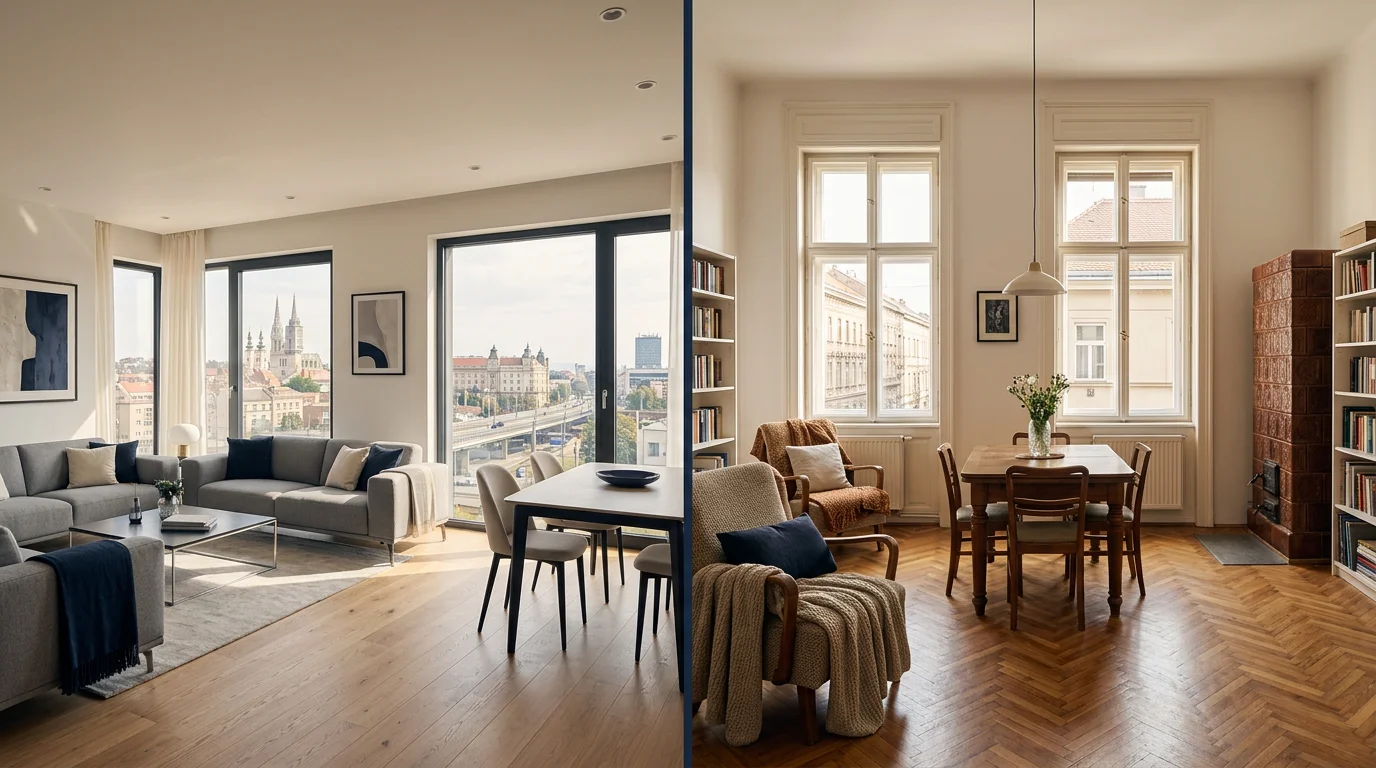
Sometimes the hardest part of buying property comes when you find two apartments that you like almost equally.
One may have a better location, while the other is larger. One may be fully renovated, while the other has a better layout and more potential for customisation. One may cost more per square metre but include a garage and balcony. The other may be cheaper but require additional investment.
At first glance, comparing them seems simple: price, size and location.
In reality, the decision is much more complex.
Two apartments of the same size do not necessarily have the same value, just as the more expensive apartment is not automatically the better purchase. It is more useful to consider the complete picture of the property and the costs it will create over time, rather than focusing only on the number attached to the asking price.
Price is the starting point, not the conclusion
Price is the easiest thing to compare.
If one apartment costs €220,000 and the other €240,000, the difference is €20,000. But that figure alone does not tell you very much.
What are you getting for the additional €20,000?
Perhaps the second apartment has 10 m² more. Perhaps it is fully renovated. Perhaps it has a garage, a larger terrace or a better location. But it is also possible that the difference is largely based on the seller's asking price.
It is therefore more useful to consider price in relation to what you are actually getting.
Price per square metre can be a useful starting point, but it is not enough to value a specific apartment. For example, Croatia's Central Bureau of Statistics reported an average price of €2,994 per m² for sold new dwellings in the first half of 2026, with €3,518 per m² in Zagreb. Such averages provide wider market context, but they are not valuations of individual apartments.
A 70 m² apartment in a strong micro-location, with parking and an efficient layout, cannot meaningfully be compared with another 70 m² apartment simply because the floor area is the same.
Location can change the entire comparison
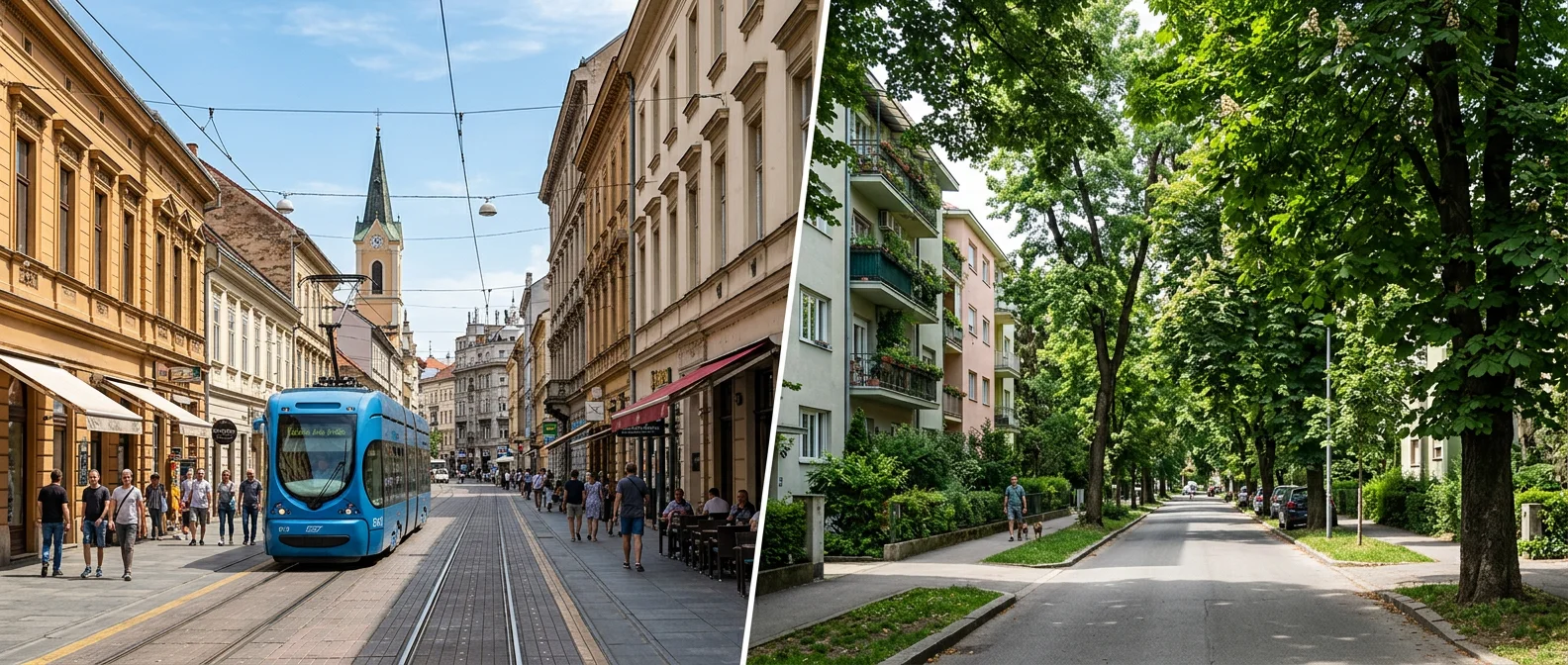
If two apartments are in different locations, location may matter more than a few additional square metres.
An apartment closer to the city centre, public transport, schools, workplaces, shops or green spaces may mean shorter daily journeys and a different quality of life.
A more distant location, however, may offer more space, peace, parking or better access to nature.
Instead of asking: “Which neighbourhood is better?”, it can be more useful to ask: “Which location fits the way I will actually live?”.
For someone who commutes by public transport every day, an additional 15 minutes each way may matter more over the long term than a few extra square metres.
For a family with children, schools, nurseries, parks and walkability may be more important.
For someone working from home, peace, natural light and the possibility of a dedicated workspace may have greater value.
Floor area is not the same as usable space
Two 70 m² apartments can feel completely different.
One may have a generous living room, two functional bedrooms, enough storage and a good flow between rooms.
The other may have long corridors, small bedrooms and relatively little usable space.
That is why total floor area is not enough.
The floor plan matters.
Think about how the apartment will actually be used every day. Where will you work? Where will you store things? Can a child's bedroom be arranged properly? Is there room for a dining table? Can the kitchen function comfortably without disrupting the rest of the living space?
An apartment with slightly fewer square metres can work much better in everyday life than a larger property with an inefficient layout.
A newly renovated apartment is not automatically the better choice
One of the most obvious differences between two apartments is their condition.
If one apartment is fully renovated, it is easy to assume that it must be the better option.
But renovation has a cost – and that cost is often already reflected in the asking price.
The other apartment may look less attractive but have a better building, a better layout or a better location. If the price is sufficiently lower, there may be room to renovate it according to your own needs.
On the other hand, a property requiring extensive renovation is not automatically an opportunity. Installations, windows, heating, cooling, bathrooms, kitchens and unexpected works can significantly increase the total investment.
It is therefore more useful to compare:
purchase price + required investment
rather than simply:
purchase price.
What is actually included in the price?
Two listings can look almost identical until you examine what is actually included.
Is there a parking space? Garage? Storage room? Balcony? Terrace? Furniture? Air conditioning?
These characteristics can significantly affect both value and everyday usability.
It is particularly important to distinguish between what is legally part of the property and what simply appears to be part of the offer.
A documented parking space associated with the property is a different proposition from simply having access to public parking outside the building.
When comparing two apartments, look at what you are actually buying.
Floor, orientation and natural light
The floor can affect the living experience almost as much as location.
A ground-floor apartment may be practical and have a garden or terrace, but may offer less privacy. A top-floor apartment may have better views and more light, but the condition of the roof and thermal performance become more important.
Neither floor is automatically better.
Orientation matters too. A living room facing south and an apartment with predominantly north-facing windows can have very different levels of daylight and solar heat.
It is also worth considering what is outside the windows. An open view today may not remain unchanged for ten years if surrounding land is undeveloped.
The building is part of the property
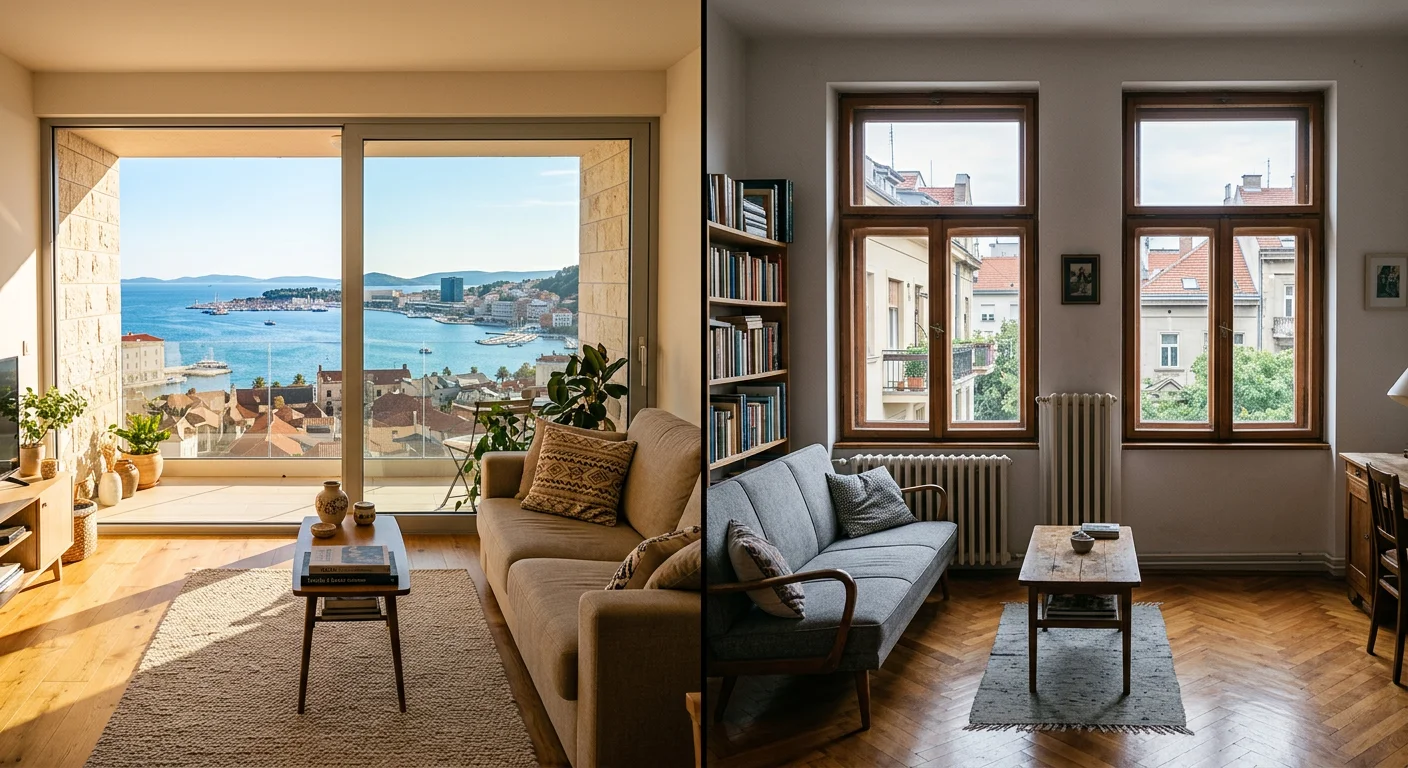
When comparing apartments, it is easy to forget that you are buying part of a building, not just an interior.
Two similarly renovated apartments can have very different long-term costs if they are in buildings of different quality.
Consider:
roof and façade condition
lift
shared installations
entrance and stairwell
energy performance
building reserve fund
planned works
major upcoming investment
The Croatian Government recommends checking the land registry extract, relevant construction documentation, use permit and energy certificate when purchasing property.
This matters particularly when comparing two apartments because one may appear cheaper precisely because the building is likely to require significant investment.
Monthly costs can matter more than the difference in purchase price
Buyers often compare purchase prices without considering that an apartment will remain a financial part of their lives for many years.
An apartment that is €15,000 more expensive may have better energy performance, higher-quality windows, lower heating costs and fewer maintenance requirements.
Conversely, a cheaper apartment may require renovation, have a higher building reserve contribution or involve greater utility costs.
It is therefore useful to think about the total cost of ownership, rather than only the purchase price.
That can include the purchase and transaction costs, taxes, financing, renovation, building reserve contributions, utilities, maintenance and larger future repairs.
Documentation can decide between two similar apartments
Sometimes two apartments look almost identical until you examine the documentation.
One may have a clear land-register position and complete documentation. The other may have discrepancies, encumbrances or questions relating to legality or registration.
That does not necessarily mean every discrepancy cannot be resolved, but it can affect the risk, time and cost involved in the purchase.
The land registry extract is the official proof of ownership and other rights that can be registered in the land register.
If you are comparing two similarly priced apartments, certainty around the documentation can matter more than a small difference in floor area or interior finishes.
Do not compare only what you can see
Listing photographs show the interior, but they do not always show the things that will have the greatest impact on your living experience over time.
They may not reveal:
noise in the morning and evening
neighbours
roof condition
insulation quality
traffic around the building
future construction
installation condition
damp
the actual quality of communal areas
That is why two apartments should also be compared beyond the listing itself.
One may look better in photographs, while the other may actually be more comfortable to live in.
What if you simply like one apartment more?
Buying a home is not purely a mathematical decision.
Perhaps one apartment has an exceptional view. Maybe you have always preferred one neighbourhood. Perhaps one space simply feels like somewhere you can imagine building your life.
That is not an irrelevant consideration.
But it is useful to separate the emotional response from the question of whether the price makes sense relative to what you are getting.
This is where comparison can help. It does not remove the subjective part of the decision; it puts it into context.
If one apartment costs more, it is worth understanding why.
There is no single “best” apartment
Comparing two apartments does not necessarily have to end with one being declared the winner.
One may be better for everyday life, while the other may make more sense financially.
One may be better for a family, while another may suit someone working from home.
One may be ready to move into, while the other may offer more potential to create a home around your own needs.
Property value therefore cannot be reduced to a single number.
Croatia's Central Bureau of Statistics reported that residential property prices increased by 14.3% year-on-year in Q1 2026, while existing residential property prices increased by 16.1%. In this kind of market environment, comparing specific properties becomes particularly important because an average market price cannot tell you what an individual apartment is worth.
Ultimately, the most useful comparison is not the one that finds the apartment with the most square metres, the lowest price or the newest interior.
It is the comparison that allows you to answer one simple question:
Which of these two apartments better fits the way I want to live – and does its price make sense for what I am getting?
On Loko, you can search for properties by location, price, size and other characteristics and compare different options. When two apartments make it onto your shortlist, looking at the complete picture can help you make a decision based on more than a first impression.