How Much Should You Offer for a Property and How to Negotiate the Price
Once you find a property you like, one of the most important questions is no longer only “Do I like it?”, but “How much should I offer for it?”

The asking price in a listing is a starting point, but it does not necessarily become the final sale price. There may be room for negotiation between the asking price and the price a buyer is ultimately willing to pay – but that room varies from one property to another.
Some sellers may be open to negotiation. Others may already have several interested buyers. In some cases, a lower offer can be justified by the property's condition, required investment or time on the market. In others, there may be little reason for the seller to reduce the price.
Good negotiation therefore does not start with “How much can I get the price down?”
It starts with: “What price makes sense for this particular property?”
The asking price is not the same as the property's value
The price shown in a listing primarily represents the seller's expectation. It may be based on comparable properties, a previous valuation, the owner's personal assessment or simply the amount they would like to receive.
That does not mean the asking price is wrong.
But the asking price alone is not enough to determine what a property is worth.
There are significant differences between locations in Croatia. Even within the same city, differences can be substantial.
That is why comparisons need to be as specific as possible. A 70 m² apartment cannot simply be compared with any other 70 m² apartment.
Location, floor, orientation, condition, parking, balcony, building quality and layout can all affect value.
Before making an offer, understand what you are actually buying
A sensible offer starts with understanding the property.
Two apartments of the same size in the same neighbourhood can have very different values.
One may be newly renovated, have parking, a balcony and good orientation. Another may require extensive renovation, have high maintenance costs or an inefficient layout.
Before deciding on an offer, it is therefore worth looking at the complete picture:
location and micro-location
size and functionality
condition of the apartment
condition of the building
floor and whether there is a lift
orientation and natural light
balcony, terrace, garden or views
parking or garage
energy efficiency
required investment
legal status
time on the market
The more closely your offer is connected to the actual characteristics of the property, the easier it is to explain why a particular price makes sense.
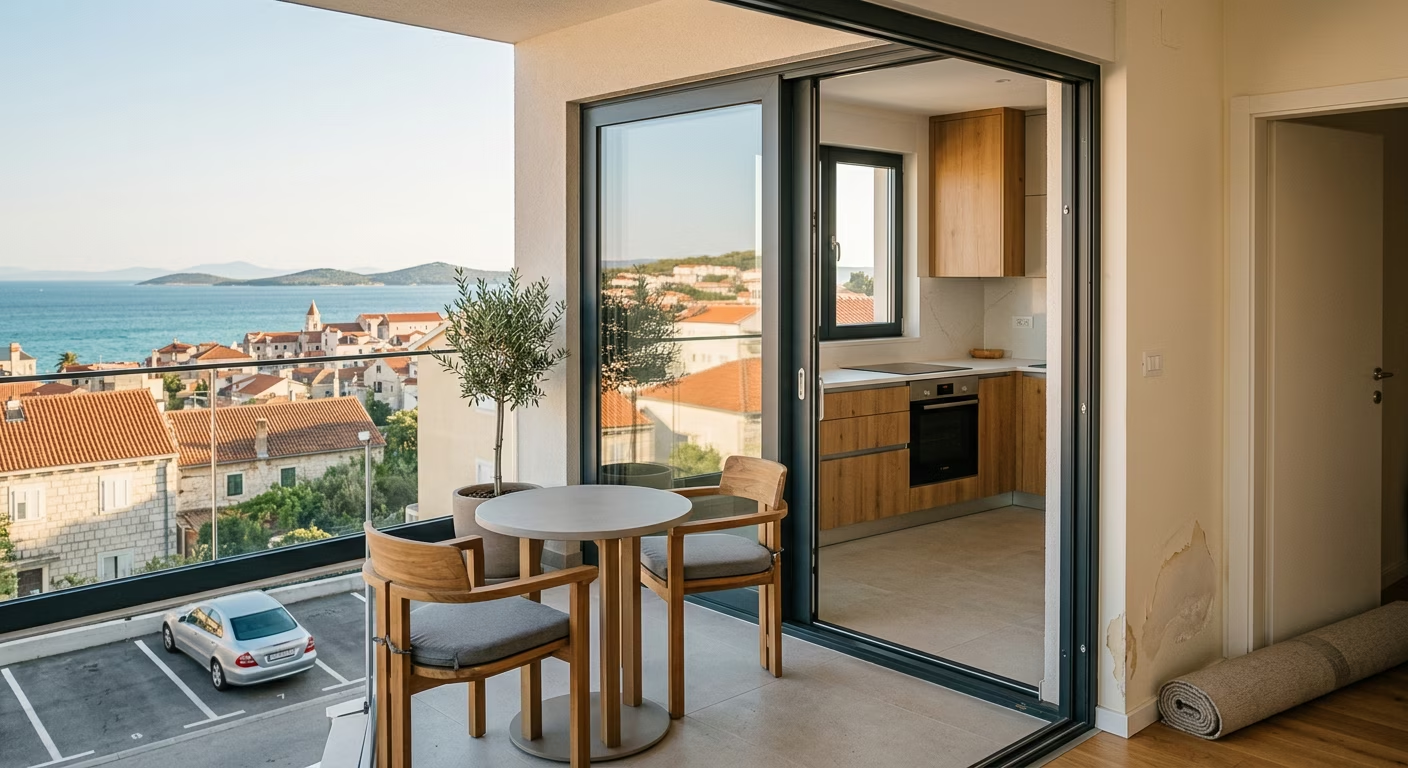
Comparable properties matter more than a single listing
One of the best ways to understand whether a price is reasonable is to compare the property with similar properties on the same market.
But “similar” does not simply mean the same floor area.
If you are looking for a 60–70 m² apartment in Zagreb, for example, it is more useful to compare properties in the same or a very similar neighbourhood, with comparable age and condition, than to use the average price for Zagreb as a whole.
It is even more useful to compare several characteristics at once.
A 65 m² apartment on the fourth floor without a lift does not necessarily have the same value as a 65 m² apartment on the first floor with a lift and garage, even if they are on the same street.
On Loko, you can search for properties by location, price, size and other characteristics, making it easier to compare different options available on the market.
How much of a discount makes sense?
There is no universal percentage for negotiating a property price.
An offer 5% below the asking price may be reasonable in one situation, while even 2% may be difficult to justify in another.
There may be more room for negotiation when:
the property has been on the market for a long time
the price has already been changed several times
significant investment is required
the property has disadvantages compared with comparable listings
there are relatively few potential buyers
the seller values a quick sale
the asking price is noticeably above comparable properties
On the other hand, there may be less room when the property is unusual or difficult to replace, competitively priced or attracting several interested buyers.
Time on the market alone does not prove that a property is overpriced. The reason could be the property's particular characteristics, seasonality, a limited pool of potential buyers or simply a seller who is unwilling to accept a lower price.
Why can time on the market matter?
If a property has only been listed for a few days, the seller may have little reason to make a significant reduction.
After several months, the situation may be different.
A long time on the market can indicate that the asking price does not fully match buyer interest. But it does not automatically mean the property is overpriced.
The property may simply be unusual. It might have an unconventional layout, a large amount of space or characteristics that appeal to only a limited number of buyers.
It can also be useful to look at price changes over time.
If the property has already been reduced several times, that may indicate that the seller has been adjusting expectations to market interest. If the asking price has remained unchanged for a long period, the negotiation dynamics may be different.
“This is my budget” is not necessarily the strongest argument
A buyer may begin a negotiation by saying: “I can offer X because that is my maximum budget.”
That may be true, but it does not by itself explain why the property is worth that amount.
A seller may be more interested in why the proposed price is justified.
For example:
“We compared several apartments of a similar size in this neighbourhood. We really like the location, but the bathroom and installations will need to be renovated. Based on that, we would be prepared to offer X.”
This demonstrates that the offer is not an arbitrary discount. It is connected to the actual characteristics and costs associated with the property.
That does not mean the seller will accept it. Negotiation is, after all, a conversation between two parties.
Negotiation is not only about the price
Price is the most visible part of a property negotiation, but it is not the only one.
The seller may care about the completion date, handover, certainty of the buyer, payment arrangements or how quickly the transaction can proceed.
The buyer may care about furniture, whether a garage or storage unit is included, specific deadlines or conditions in the sale agreement.
Two offers at exactly the same price can therefore have different levels of attractiveness.
In some situations, a seller may accept a slightly lower price if the transaction is straightforward and highly likely to proceed.

An unrealistically low offer can end the conversation
Negotiation does not automatically mean offering as little as possible.
If an offer is significantly below the asking price without a clear rationale, the seller may simply consider it unrealistic and refuse to continue the discussion.
This is particularly relevant when the property is already competitively priced.
At the same time, your initial offer does not necessarily have to equal the maximum amount you would be willing to pay. Negotiation naturally creates some space between the initial positions of buyer and seller.
The important thing is that this space should be based on information rather than simply a desire for a discount.
What if the seller rejects your offer?
A rejected offer does not necessarily mean that negotiations are over.
The seller may respond with a counteroffer. The buyer can then reconsider the overall value of the property and decide whether it still makes sense to continue.
At that point, it is useful to return to the basic question:
Would I still consider this property a good purchase at that price?
If the answer is yes, the difference between the initial offer and the counteroffer may not be decisive.
If the answer is no, trying to reduce the price simply to “win” the negotiation is unlikely to be useful.
The goal is not necessarily to achieve the lowest possible price. It is to agree on a price that makes sense for the property and for the buyer's decision.
When is it better not to negotiate too aggressively?
There are situations where focusing too heavily on negotiation can actually be counterproductive.
If a property is rare, competitively priced and attracting other buyers, an aggressive attempt to reduce the price may mean losing the opportunity.
On the other hand, if there are serious problems with the property, they should not simply be treated as an excuse for a lower offer. Legal or structural issues need to be understood and assessed first.
Price needs to be considered in the context of what you are actually buying.
A good offer is based on research, not guesswork
Determining the right offer is not an exact formula.
Market value can differ from the asking price, and the final sale price is ultimately established when a buyer and seller agree to complete the transaction.
The most important thing is therefore to have enough information: comparable properties, location, condition, required investment, time on the market and all the characteristics that distinguish the property from alternatives.
Ultimately, the question is not: “How much can I get the seller to reduce the price?”
A more useful question is: “How much is this property worth to me compared with the other options available?”
That perspective can help keep negotiations rational – and make sure that the price you offer is connected to the property you are buying, rather than simply to the number shown in the listing.
On Loko, you can search and compare properties by location, price, size and other characteristics. The better you understand the alternatives available on the market, the easier it becomes to decide how much you are prepared to offer for the property you like most.