Apartment to Renovate – When Does Buying One Make Sense?
An apartment that needs renovation can initially look like a less attractive option than a fully finished property. Yet properties in need of renovation can sometimes represent an interesting opportunity.
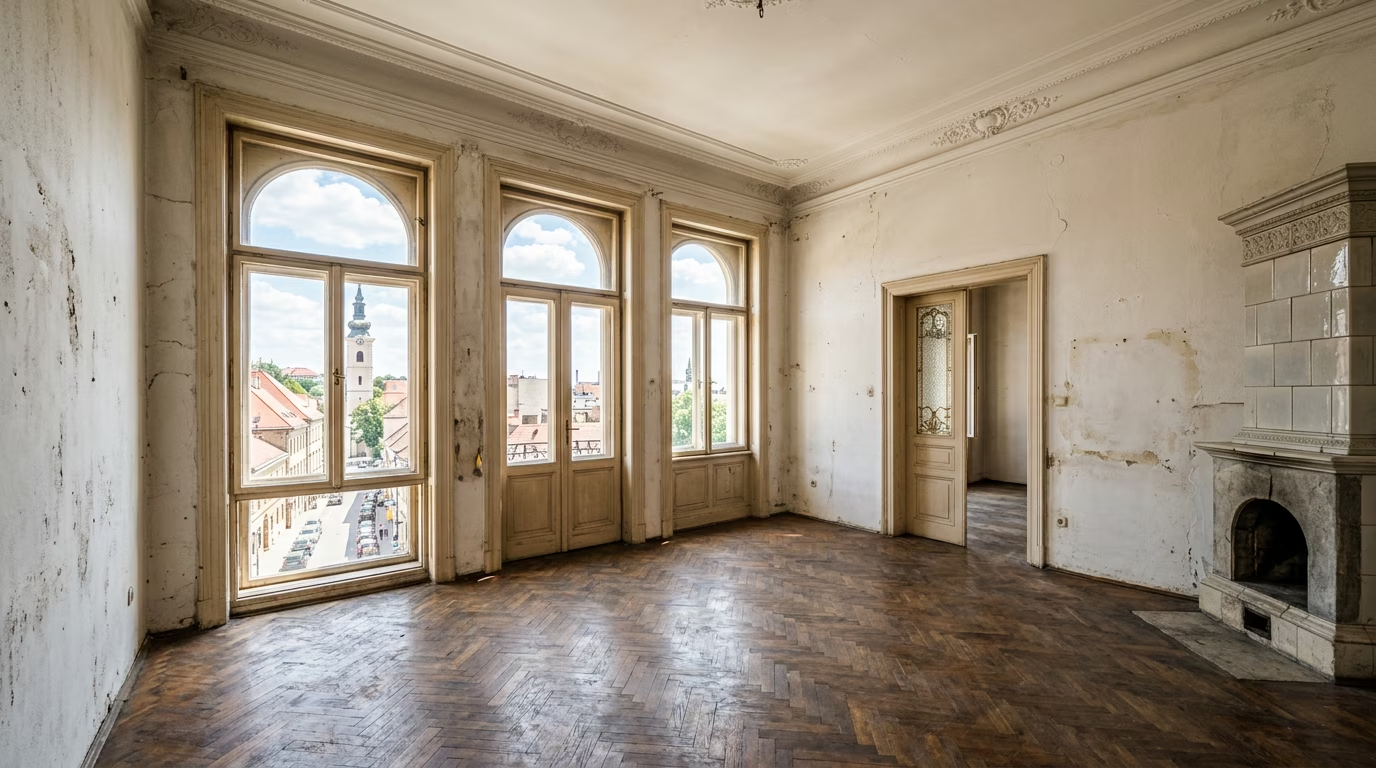
A buyer may be able to secure a better location, more space or a more attractive floor plan for the same budget that would only buy a smaller or less desirable property in move-in condition.
On the other hand, renovation costs can quickly turn an apparently affordable purchase into an expensive project.
So the real question is not simply “How much will the renovation cost?”
It is: “Will the total investment make sense compared with the value and alternatives available once the renovation is complete?”
Why can renovation properties be attractive?
One of the biggest advantages of buying a property that needs renovation is that you are not necessarily paying for someone else's renovation.
The asking price of a fully renovated apartment often reflects not only the work itself, but also the time, design choices and effort that went into completing it.
With a property that needs renovation, some of that potential is still unrealised.
This can be particularly interesting in desirable neighbourhoods where larger or well-located properties are difficult to find.
An older apartment might have a good structure, high ceilings, generous rooms and excellent orientation, while the kitchen, bathroom and installations are outdated. A buyer willing to renovate can then adapt the property to their own needs.
There is, however, an important distinction between an outdated apartment and a property with serious structural or legal problems.
The first can be an opportunity. The second can become a very expensive problem.
A lower purchase price does not automatically mean a saving
Properties in need of renovation are often compared with finished apartments on a price-per-square-metre basis.
If a renovated apartment in the same area costs €3,500 per m² while an apartment requiring renovation costs €2,800, the €700 difference may initially appear to leave plenty of room for improvement.
But the purchase price is only the beginning of the calculation.
The total investment may include:
purchase price
taxes and transaction costs
architect or designer fees
construction and trades
new installations
windows and doors
flooring and wall finishes
kitchen and bathroom
heating and cooling
lighting and furnishing
unexpected work
With older properties, it can be particularly difficult to estimate the full cost in advance because some problems only become visible once the work begins.
That is why an apartment costing €2,800 per m² is not necessarily cheaper overall than a renovated apartment costing €3,500 per m².
The important figure is the total investment.
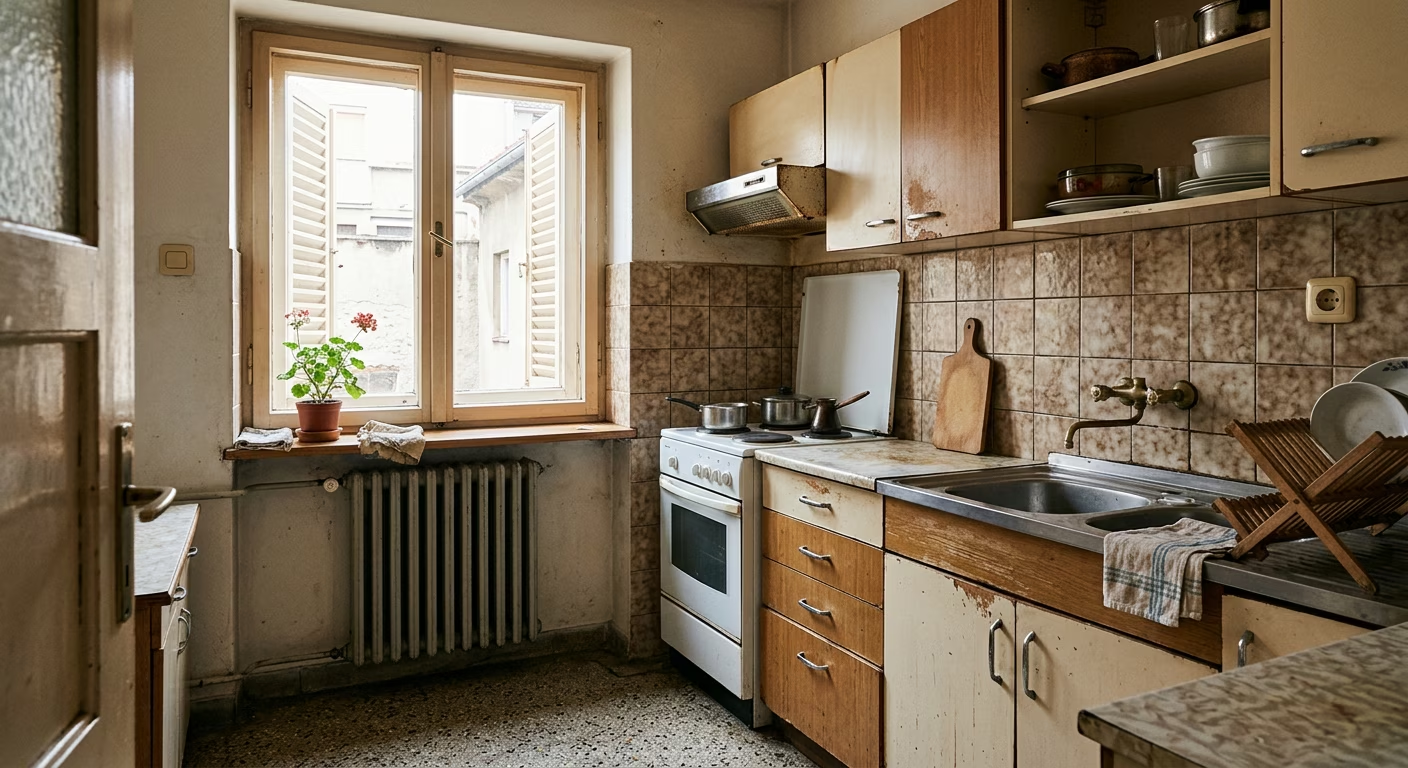
Location can matter more than the condition of the apartment
There is one advantage that cannot be renovated: location.
You can completely replace a bathroom. You may be able to remove internal walls if technically and legally possible. Floors, windows, kitchens and heating systems can all be changed.
But you cannot move the property closer to the city centre, public transport, a school, the sea, a park or an employment centre.
This is why an apartment in a strong location that needs renovation can sometimes make more sense than a beautifully finished apartment in a location that does not suit your long-term needs.
This is particularly relevant in neighbourhoods where supply is limited. Renovation can be a way of accessing a property in an area where move-in-ready homes are scarce.
Floor plan potential can be worth more than new finishes
Older apartments can be deceptive.
An outdated kitchen and worn flooring may make a property look unattractive at first glance, even though the underlying space has excellent qualities.
High ceilings, large windows, good orientation, generous living areas or the possibility of reorganising rooms can have more long-term value than a fashionable interior.
Other problems are much harder to solve.
Limited natural light, poor orientation, a very inefficient floor plan, excessive noise or restrictions within the building may remain problems even after a major renovation.
That is why the potential of the space should be assessed separately from its current appearance.
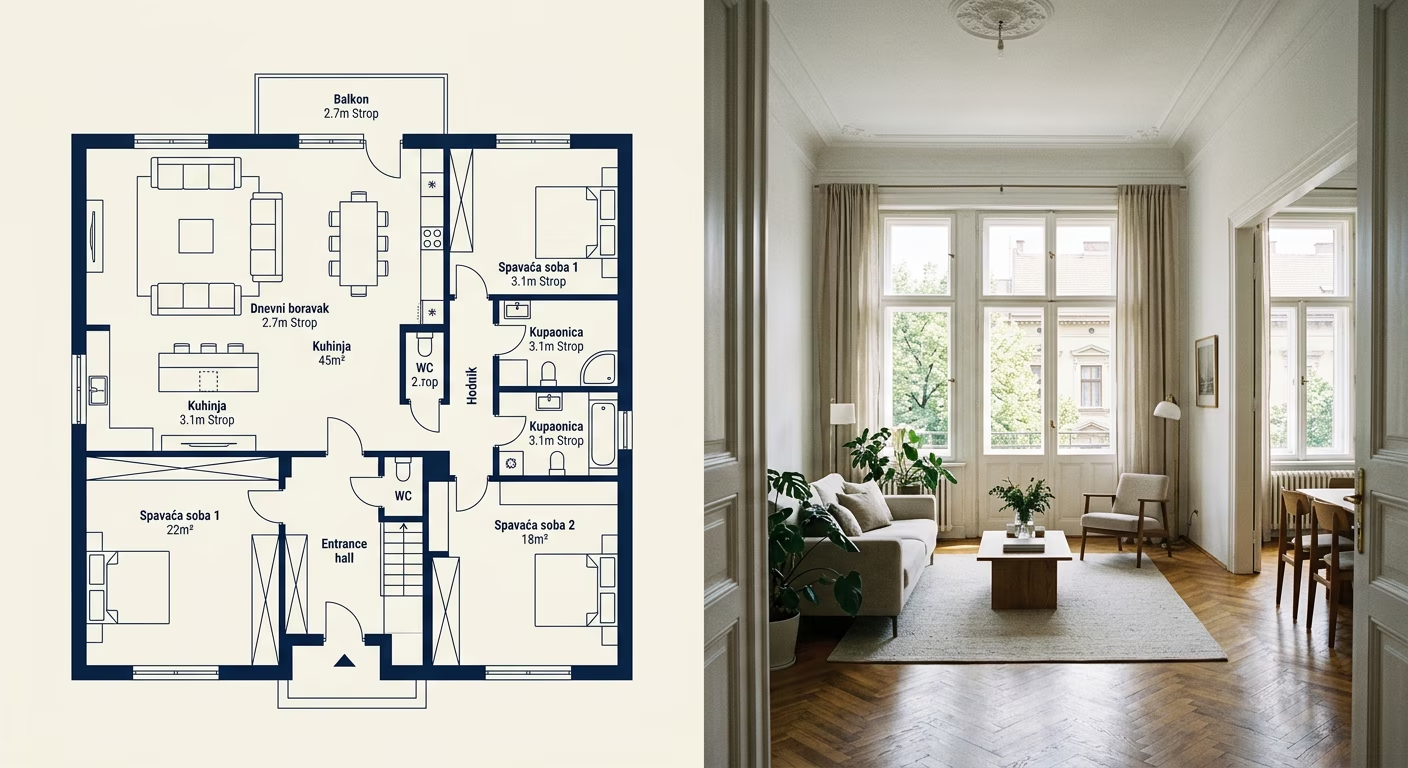
Renovation is more than cosmetic improvement
One of the most important distinctions is between redecorating and genuinely renovating a property.
A new kitchen, flooring and bathroom tiles can completely change the appearance of an apartment. But if the electrical or plumbing systems are outdated, they may soon require further investment.
The same applies to heating, cooling, windows, insulation and the condition of the building's shared areas.
Energy renovation can also have practical value. Croatia's Ministry of Physical Planning, Construction and State Assets notes that renovated buildings can have lower energy needs, improved quality and safety, and potentially higher value. In June 2026, funding was secured for an additional 269 multi-apartment building energy-renovation projects.
This is why buyers of older apartments should look beyond the interior. Sometimes the more important question is what is happening with the building as a whole.
How much renovation is enough?
There is no universal percentage or budget that determines whether renovation makes financial sense.
The answer depends on the relationship between the purchase price, renovation cost, location, size and characteristics of the apartment, and the prices of comparable properties once renovated.
Consider a simple example.
Imagine a 70 m² apartment:
Apartment requiring renovation
purchase price: €2,700/m²
purchase price: €189,000
renovation and additional costs: €50,000
total investment: €239,000
Renovated apartment in the same area
price: €3,400/m²
price for 70 m²: €238,000
In this example, the difference almost disappears.
Renovation does not automatically create a financial advantage. But if the apartment can be purchased significantly below comparable properties, or if the renovation creates a better layout and quality than similar finished apartments, the calculation can look very different.
The key is therefore the difference between the purchase price and the realistic total cost of renovation, rather than the purchase price per square metre alone.
Unexpected costs can change the entire calculation
There is another challenge with renovation: what you cannot see before buying.
Once flooring is removed, the underlying surface may turn out to be damaged. Removing tiles may reveal problems with plumbing. Older buildings can have issues with shared installations, damp or other parts of the building.
This is why having a financial reserve matters.
If the entire budget has already been allocated to the purchase and planned works, one unexpected problem can significantly disrupt the project.
Buying a renovation property is therefore not only a financial investment. It is also a project with a degree of uncertainty.
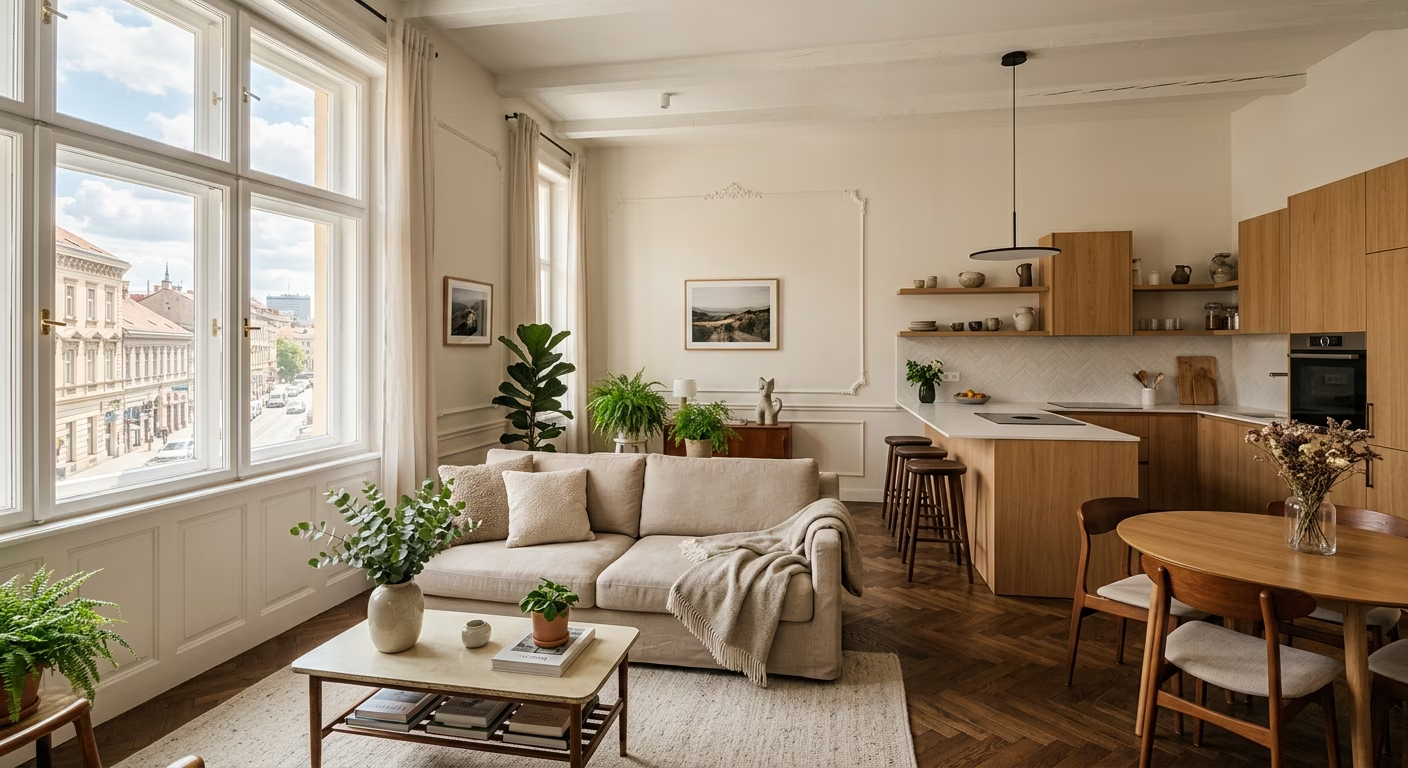
When can a renovation property make the most sense?
A renovation property can become particularly interesting when several factors come together.
For example, when:
the location suits your long-term needs
the apartment has a good floor plan or potential for improvement
the building is in good condition
the property's legal status is clear
the purchase price leaves sufficient room for renovation
you can realistically finance the renovation
you have the time or professional support to manage the work
the finished property makes sense compared with comparable apartments in the same area
The most interesting opportunities are not necessarily the properties that look the worst. They are often the ones where the gap between the current condition and the property's potential is the greatest.
When might renovation not make sense?
There are also situations where a low price should be treated as a warning rather than an opportunity.
If the property has structural problems, serious damp, major installation issues, unresolved ownership or other legal complications, cosmetic renovation will not solve the underlying problem.
The same applies when the total cost of buying and renovating comes close to the price of a good-quality finished apartment in the same location.
In that situation, the buyer is taking on additional risk and work without necessarily gaining a corresponding financial or practical advantage.
Renovation can make it possible to buy something you otherwise could not find
Ultimately, the value of a renovation property is not only about saving money.
It may allow you to buy in a neighbourhood where there are very few properties available. It may give you more space than you could afford in a new or fully renovated apartment. Or it may allow you to create a home that genuinely matches the way you live.
That is why renovation can make sense when the property already has valuable fundamentals – location, size, layout, natural light and building quality – while the shortcomings can realistically be improved.
In a market where residential property prices remain high, that distinction can matter. In Q1 2026, Croatia's house price index was 14.3% higher year-on-year, while prices of existing residential properties increased by 16.1%.
But renovation does not create value by itself.
Value is created when the price, location, condition of the property and cost of renovation can be brought together into a sensible overall investment.
On Loko, you can search properties by location, price, size and other characteristics and compare different apartments before deciding whether a move-in-ready property or a renovation project is the better fit for you.